Guides › Automatic Transmission Fluid Leak: Find the Source
Automatic Transmission Fluid Leak: Find the Source
Red fluid under the truck? Confirm it's ATF, clean everything, then recheck to find the highest wet point: pan gasket, lines, seals, or the front pump. Safety-first, no guessed specs.
⚠️ Safety first
- Automatic transmissions run hot (roughly 150–250 °F). Let the vehicle cool before working near the pan, cooler lines, or exhaust.
- Never get under a vehicle held up only by a jack. Use rated jack stands in pairs on hard, level ground, chock the wheels left on the ground, and shake-test the vehicle before crawling under.
- Fire risk: ATF dripping on a hot exhaust can ignite. Exhaust parts under load can run hotter than the temperature at which ATF ignites on a hot surface. Fix leaks that reach the exhaust and clean off residue before driving.
- For engine-running checks, keep hands, sleeves, and lights away from the fan, belts, and driveshaft. Have a helper, set the parking brake, and chock the wheels.
- Wear eye protection when working under a dripping transmission.
Steps
- Confirm it's transmission fluid. Wipe the drip onto a white paper towel: red or reddish-brown fluid points to ATF. Engine oil from a valve cover or rear main seal can run back and look like a transmission leak, so don't assume.
- Clean the area. With everything cool, clean the pan rail, case, bellhousing area, cooler lines, and the back of the engine with a nonflammable cleaner so old residue doesn't mislead you.
- Run and recheck. Bring the transmission up to operating temperature with the vehicle safely supported or parked, then look for fresh fluid and trace it to its highest wet point. Fluid runs downhill and blows back, so the lowest drip is rarely the source.
- Pan gasket and pan: look for wetness along the pan rail. Make sure all the old gasket was scraped off and check that the pan flange is flat. Over-tightened pan bolts dimple the pan rail around the bolt holes and cause leaks. Get the pan bolt torque from your service manual or the gasket/pan maker; never guess.
- Drain plug (if fitted) and filter/pickup: check the plug and its washer. A misplaced filter seal can cause fluid problems after a pan job.
- Cooler lines and fittings: check both ends, at the transmission case and at the radiator, plus any rubber hose sections. Don't keep tightening a fitting to stop a leak; replace the worn part. ATF in the radiator coolant points to a leaking cooler inside the radiator.
- Dipstick (filler) tube seal at the case, which can be disturbed during a pan job.
- Shift shaft (selector) seal and TV/kickdown cable seal on the side of the case, plus any electrical connector.
- Front of the transmission (between engine and trans): fluid on the back of the torque converter suggests the front pump seal. Fluid only on the inside of the housing suggests the pump gasket or pump bolts. Front leaks usually mean removing the transmission, which is shop work for most people.
- Rear of the transmission: check the extension housing (tailshaft) seal at the driveshaft yoke, the output seal, and the speedometer gear/sensor seal.
- Still can't find it? Add a fluorescent leak dye made for ATF, drive, and inspect with a UV light.
- After the repair, refill to the correct level using the manual's check procedure (overfilling causes foaming and overheating), then clean and recheck for leaks.
- Older GM trucks (TH350/TH400/700R4): before buying gaskets or seals, identify which transmission you have, for example by the shape of the pan. This is general identification help, not a spec. Confirm with the service manual or a transmission shop.
Tools & parts
Tools & parts
- Rated jack stands (pair) and wheel chocks, or ramps
- Flashlight
- White paper towels or cardboard
- Nonflammable parts cleaner and rags
- Drain pan
- Safety glasses & gloves
- Fluorescent leak dye and UV light (optional)
- Your vehicle's service manual
Disclosure: links below are paid Amazon search links; as an Amazon Associate we earn from qualifying purchases, at no cost to you. Learn more.
- Jack stands (pair) — Holds the vehicle securely while you inspect underneath. ⚠️ Use on hard, level ground; never work under a jack alone. view options (paid link)
- UV leak detection kit — Fluorescent dye makes a hard-to-find leak glow under UV light. view options (paid link)
- Drain pan — Catches ATF when dropping a pan or disconnecting lines. view options (paid link)
- Safety glasses — Keeps dripping fluid and debris out of your eyes. view options (paid link)
🛑 When to call a pro
- The leak is at the front (bellhousing) area: the pump seal usually needs the transmission removed.
- ATF shows up in the radiator coolant, or coolant shows up in the ATF.
- Fluid is burnt, dark, or full of debris, or the transmission slips or shifts badly.
- You can't safely support the vehicle or don't have the service manual specs.
Printable checklist
Printable checklist
WrenchReady — Automatic Transmission Fluid Leak: Find the Source · Date: ________ Vehicle: ________________
Video walkthrough
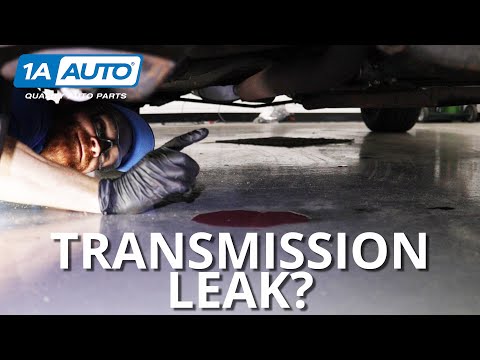
Third-party video from YouTube; not produced or endorsed by us. Tap play to load. Always follow your service manual.
More videos (2)


FAQ
FAQ
What color is transmission fluid?
Most automatic transmission fluid is red when new and turns brownish with age. Engine oil is amber to black, and coolant is often green, orange, or pink.
Will tightening the pan bolts stop the leak?
Not usually. Over-tightening dimples the pan rail and can make it worse. Torque to the service manual spec and replace the gasket or straighten the pan instead.
Is a transmission leak a fire risk?
It can be. ATF dripping onto a hot exhaust can ignite, so fix leaks that reach the exhaust and clean off residue.
Related guides
Sources & references
References
- Ford Mustang 1999–2004 Service Manual: Leakage Inspection (automatic transmission) — Ford workshop manual text (third-party mirror)
- B&M installation instructions: TH250/TH350 deep transmission pans — B&M Racing
- Fire and Toxicity Properties of Underhood Fluids and Plastics — Motor Vehicle Fire Research Institute
- Vehicle support stands guide — ACCC Product Safety Australia
- Underhood Temperature Measurements — Motor Vehicle Fire Research Institute
Filed under: Transmission & Drivetrain · Transmission fluid leak · Cars & Trucks · RVs & Campers
Written by the WrenchReady team from general public knowledge. Specifications vary — your owner's/service manual is the authority.